Neutron users talk compact neutron sources on CBC radio
Neutron beam users from University of Windsor discuss their interests in a compact accelerator based neutron source.

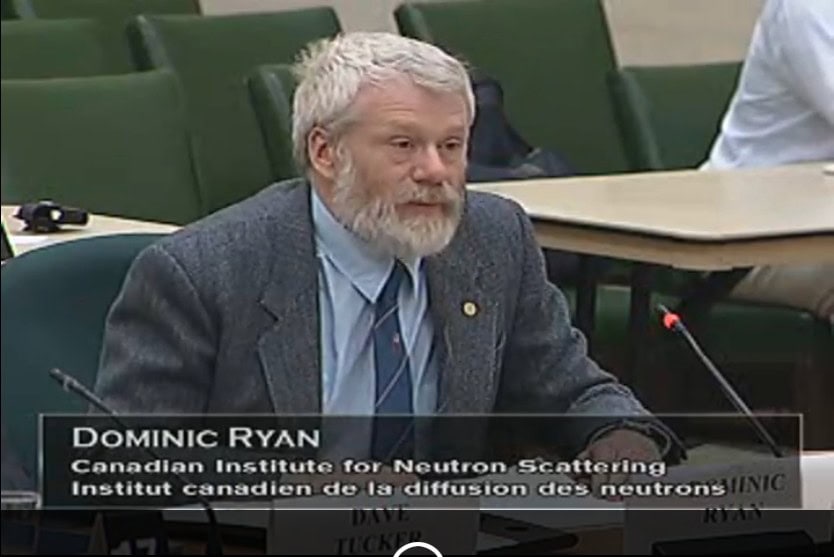
In neutron science, Ryan contributed across multiple techniques, including neutron powder diffraction, depolarization, and reflectometry, and was particularly known for overcoming experimental barriers to “do the impossible.” His development of methods such as the flat‑plate sample geometry enabled neutron studies of highly absorbing materials previously considered inaccessible, opening new avenues in the study of rare‑earth magnetic systems and functional materials. Through this work, he helped demonstrate both the power and versatility of neutron scattering as a probe of complex matter.

Yet Ryan’s contributions extended far beyond the laboratory. He was a central figure in building and sustaining Canada’s neutron community through his leadership in the Canadian Institute for Neutron Scattering (CINS), where he served as both Vice‑President and President. In this role, he combined scientific authority with a strong commitment to collective action, consistently emphasizing that neutron science in Canada depended on national coordination, shared infrastructure, and a unified voice.
As CINS President (2004-2014), Ryan played a pivotal role in shaping the national conversation around neutron infrastructure at a critical moment. He was an advocate to government, articulating the importance of neutron beam facilities as strategic national infrastructure underpinning innovation, industrial competitiveness, and scientific excellence. His interventions helped clarify what was at stake for Canada as the NRU reactor approached the end of its life. He spoke before parliamentary committees and in national forums, emphasizing the wide-ranging impact of neutron beams on materials research, nuclear technology, manufacturing, and health, and warning of the long-term consequences of losing domestic capability without a strategic replacement. His message was consistent: neutron facilities are not optional—they are essential infrastructure for a modern scientific and industrial economy.
Most significantly, Ryan was instrumental in initiating the efforts that ultimately transformed Canada’s neutron landscape. In 2014, under his presidency of CINS, the organization began reaching out to university leadership to explore the creation of a national consortium to secure future neutron beam access and infrastructure. This effort directly led to the formation of the Canadian Neutron Initiative (CNI) working group in 2016, and in turn laid the groundwork for the establishment of Neutrons Canada as a national organization to govern, manage, and represent Canada’s infrastructure program for research and development with neutron beams.
These developments represent one of Ryan’s most enduring legacies: he helped catalyze the transition from a facility‑centric model to a coordinated, pan‑Canadian approach to neutron science—one capable of sustaining expertise, enabling access, and positioning Canada for the future. That vision continues today through Neutrons Canada and the national programs it supports.
Those who worked with Dominic remember more than his scientific and institutional achievements. He was respected and trusted, and a good friend. He brought to his work a keen sense of humour, a direct and pragmatic style, and an unwavering commitment to getting things done. Whether in the laboratory, in a committee meeting, or in national discussions, he combined seriousness of purpose with wit and approachability, making him a valued colleague and leader.
Dominic Ryan’s legacy is in advancing the frontiers of neutron scattering through innovative experimentation, training a generation of scientists, and helping to build the framework that will sustain neutron science in Canada into the future. The Canadian neutron community—and the many international collaborations he fostered—are stronger for his contributions.
He will be deeply missed, and long remembered.